AI-assisted grading: how it actually works
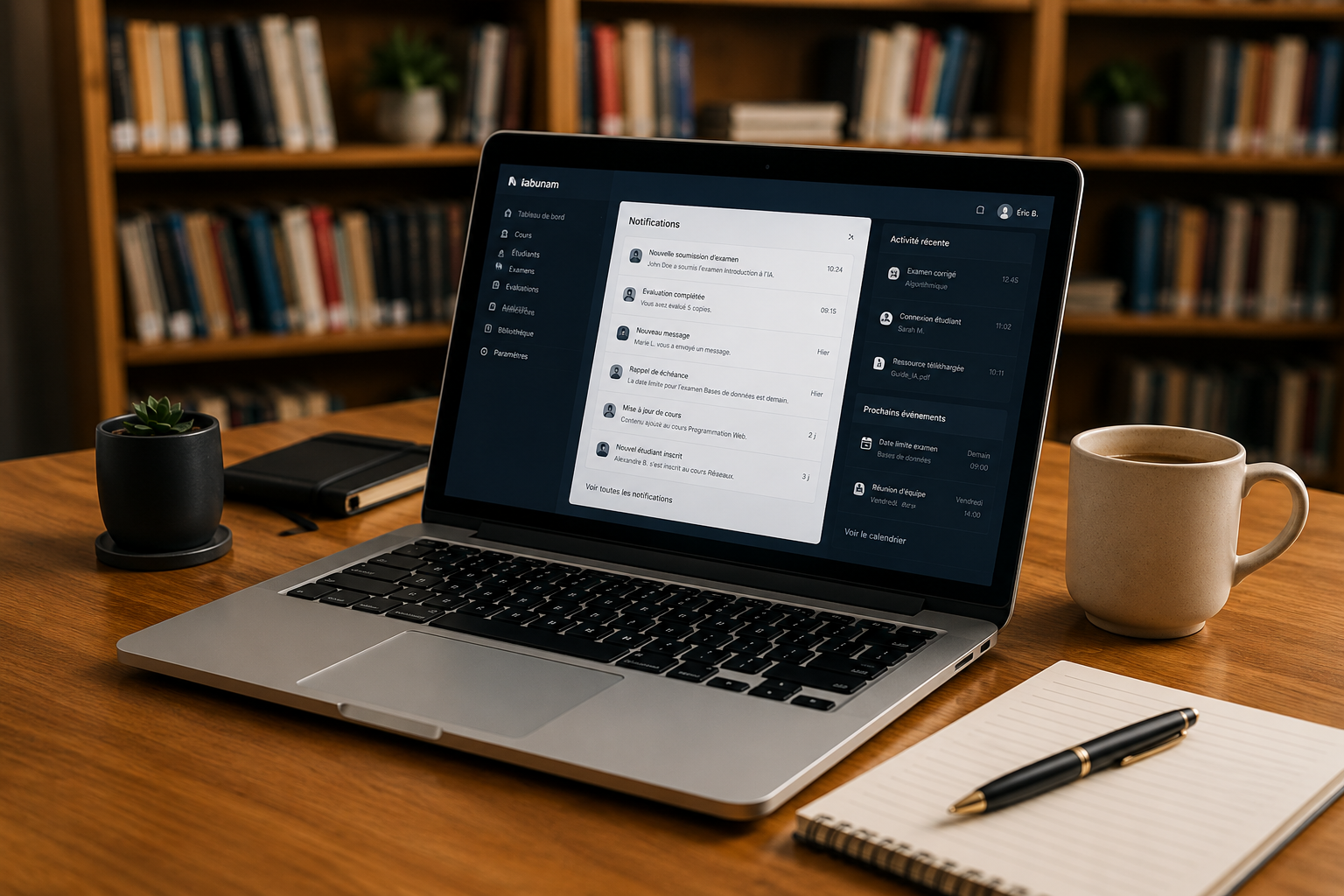
"AI-assisted grading" is a phrase that comes up often, but rarely gets explained in detail. How does a system actually evaluate a submission? And more importantly, where does the machine's work end and the teacher's begin? Understanding this mechanic helps demystify a process that can otherwise feel like a black box.
The steps involved
AI-assisted grading typically follows a three-step sequence. First, the system reads the student's response and compares it against a rubric or criteria defined by the teacher. Next, it proposes a preliminary evaluation — a grade, comments, or both. Finally, that proposal goes to the teacher, who can accept it as-is, adjust it, or reject it entirely.
That last step matters most: in a well-designed platform, AI never finalizes a grade without a responsible person reviewing it first. This validation step isn't an administrative formality — it's the mechanism that ensures the teacher's professional judgment stays at the centre of the evaluation process.
What AI does well
Current systems are particularly good at spotting objective elements: the presence or absence of a key concept, adherence to an expected structure, consistency between an answer and a specific criterion. On repetitive, high-volume tasks — dozens of similar submissions — this first pass can significantly cut down the time spent on the initial read-through.
This effectiveness is particularly notable in courses where the rubric is already well-defined, like math or applied sciences, where the presence or absence of a calculation step is relatively straightforward to verify systematically.
Where AI falls short
Nuance, a student's personal context, or an original argument that steps outside the expected format remain areas where human judgment stays irreplaceable. A system can misread a creative answer that doesn't follow the anticipated format, or miss an argumentative quality that's hard to quantify.
Why oversight stays central
This is exactly why serious platforms design AI-assisted grading as a support tool, not a replacement. Teachers keep final responsibility for every grade assigned, with the ability to review any suggestion before it reaches a student.
In a pilot project, this dynamic can be observed directly: teachers see how much time they recover on repetitive tasks, while keeping full control over the final result. That combination — time saved and control intact — is what makes the approach credible to teaching staff who are naturally cautious about a new tool.
A concrete example of the process
Take a 40-submission exam with short-answer questions. A first AI-assisted read can identify within minutes which answers clearly match the rubric, which clearly don't, and which fall into an ambiguous zone. The teacher can then focus attention on that last group, rather than spreading their time evenly across all 40 submissions as if they had no prior indication at all.
A note on rollout
It helps to start with a single type of assessment before extending assisted grading across an entire course. That progression makes it possible to adjust criteria and build trust in the system, rather than changing everything at once and having to backtrack if results aren't satisfactory.